
How Diagnostic Laboratories Should Plan Analyzer Integration: A Practical Implementation Guide
A comprehensive guide for Indian diagnostic lab owners and pathology staff on planning seamless laboratory analyzer interfacing, from communication protocols to ISO 15189 verification.
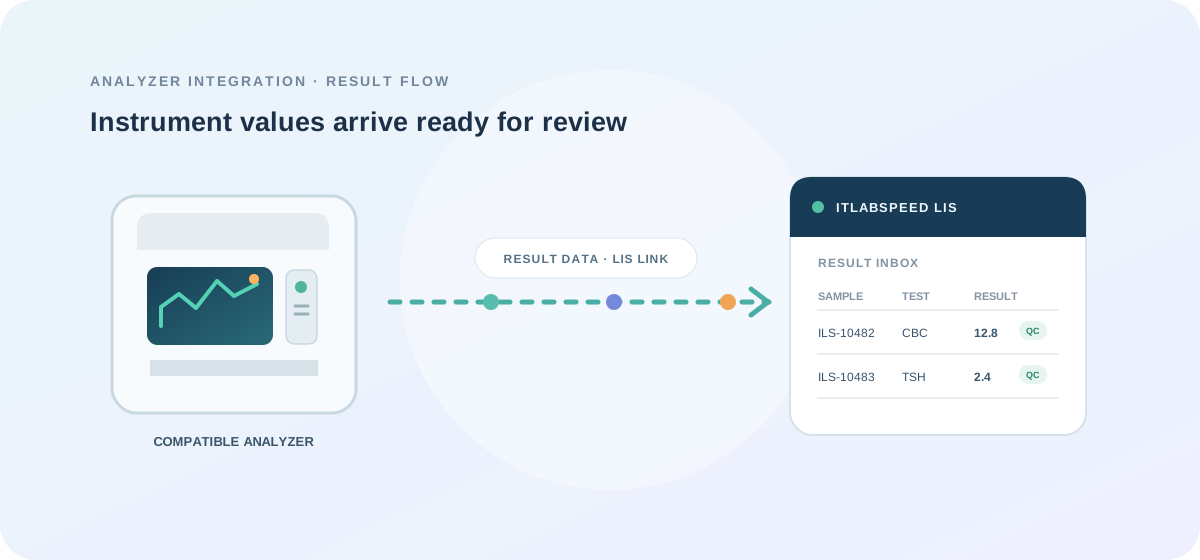
Manual data transcription remains one of the most persistent sources of transcription errors and turnaround delays in diagnostic laboratories. As testing menus broaden and daily specimen volumes grow, integrating benchtop hematology counters, automated clinical chemistry analyzers, and immunoassay platforms directly into a Laboratory Information System (LIS) is essential for operational efficiency. However, instrument interfacing is not simply a plug-and-play task. A successful integration requires evaluating communication standards, establishing resilient local network and serial connections, designing foolproof specimen identification workflows, and carrying out rigorous data verification to meet ISO 15189:2022 and National Accreditation Board for Testing and Calibration Laboratories (NABL) quality requirements.
1. Selecting the Interfacing Architecture: Unidirectional vs. Bidirectional
The first critical decision in the planning phase is determining whether each analyzer requires a unidirectional or bidirectional interface. The choice depends on instrument capabilities, daily sample throughput, and cost-benefit trade-offs across lab departments.
- Unidirectional Interface: The analyzer transmits completed test results to the LIS after processing. Laboratory technicians must manually program the test profile or load list on the analyzer console. While simpler to configure and widely supported on semi-automated or low-throughput machines, unidirectional connections do not eliminate clerical workload at the sample loading stage.
- Bidirectional (Batch/Host-Query) Interface: The analyzer actively communicates both ways with the LIS. In a host-query setup, a technician scans a barcoded tube placed directly on the analyzer carousel; the analyzer queries the LIS for pending orders mapped to that sample ID, performs the prescribed tests, and transmits the resulting data back. This setup virtually eliminates manual specimen programming on high-throughput biochemistry, immunoassay, and hematology platforms.
2. Assessing Communication Protocols and Physical Hardware
Diagnostic analyzers do not communicate in arbitrary formats; they adhere to defined medical device messaging standards. The two dominant standards encountered in Indian diagnostic settings are ASTM (specifically ASTM E1381/E1394, later published as CLSI LIS1-A and LIS2-A2) and Health Level Seven (HL7 v2.x, commonly utilizing MLLP framing). ASTM remains the predominant protocol across legacy and mid-range benchtop analyzers, whereas modern, high-throughput systems and point-of-care hubs frequently deploy HL7 over TCP/IP networks.
During procurement and planning, laboratory management must inspect the back panel and host documentation of each machine. Analyzers with RS-232 serial COM ports need serial cabling, USB-to-serial adapters, or multi-port serial-to-Ethernet converters to relay signals to the local LIS gateway or connector machine. Network-ready analyzers require dedicated static local IP addresses and designated communication ports within the laboratory’s local area network (LAN). Clarifying whether an instrument license fee is required by the analyzer vendor for opening the host interface port is crucial before signing service contracts.
3. Standardizing Specimen Barcoding and Accession Workflows
An automated interface is only as reliable as the sample identifier that binds the physical specimen to the digital record. Analyzer integration demands a disciplined accessioning and barcoding procedure at the phlebotomy and sample-receiving counters.
- Unique Identifier Design: Accession barcodes must be strictly unique, readable by the analyzer's onboard laser or camera, and format-compatible with the instrument’s barcode firmware (such as Code 128 or Code 39).
- Label Alignment and Tube Geometry: Indian diagnostic labs frequently face interface errors due to skewed, wrinkled, or poorly adhered barcode labels on primary collection tubes. Staff must be trained to align labels vertically with the window left clear for serum level sensing.
- Split and Aliquot Management: When a single collection tube must be split across multiple instruments (such as clinical chemistry and serology), the LIS workflow must generate traceable secondary aliquot barcodes that map back to the parent requisition without losing sample identity.
4. Establishing Rigorous Analyte and Flag Mapping
Even when an analyzer and an LIS establish a stable physical handshake, the data layer requires detailed translation. Every test parameter output by the analyzer uses a specific manufacturer code—such as 'SGPT' or 'ALT_2'—which must be mapped one-to-one to the corresponding test code in the laboratory's master catalog.
This mapping exercise extends beyond raw numerical values. Units of measurement must be cross-verified; an instrument transmitting calcium in mmol/L while the LIS expects mg/dL introduces severe clinical hazard. Furthermore, pathologists and technical heads must configure how the LIS interprets instrument flags. Analyzers regularly flag specimens for lipemia, hemolysis, icterus, linearity over-range, or platelet clumping. The integration rules must define whether flagged values populate automatically, trigger an auto-dilution protocol, or hold the parameter for mandatory manual review by a pathologist.
5. Verification Protocols for ISO 15189 and NABL Compliance
Under ISO 15189:2022 (Clause 7.6) and corresponding NABL guidelines, medical laboratories must verify the performance and data integrity of all information systems and automated interfaces prior to clinical go-live. Accreditation assessors inspect whether the lab can prove that data transmitted from the instrument matches the data displayed on the final patient report without alteration.
- Parallel Run Verification: Run a minimum cohort of diverse patient samples (covering normal, elevated, panic, and flagged values) simultaneously through manual entry and automated interface transfer, validating bit-by-bit concordance.
- Transmission Failure and Buffer Checks: Disconnect the network cable or shut down the receiving connector while the analyzer is processing. Verify that the analyzer queues results in its local buffer and retransmits them without duplication or packet loss upon reconnection.
- Audit Trail and Traceability: Confirm that the LIS audit log immutably records the specific analyzer ID, transmission timestamp, operator ID, and any subsequent edits made before report authorization.
6. Ensuring Local Infrastructure Resilience
In many Indian diagnostic facilities, fluctuating electrical supply and transient network dropouts present common operational hurdles. Serial cables, RS-232-to-USB converters, and local interface bridge PCs must be connected to uninterrupted power supply (UPS) systems to prevent dropped data packets or port freezes during power transfers. When working with cloud-hosted LIS platforms, lab administrators should implement a robust on-premise local listener or buffer service. This middleware holds analyzer transmissions locally if external internet connectivity drops and pushes the completed runs once the broadband link is restored, preventing analytical bottlenecks.