
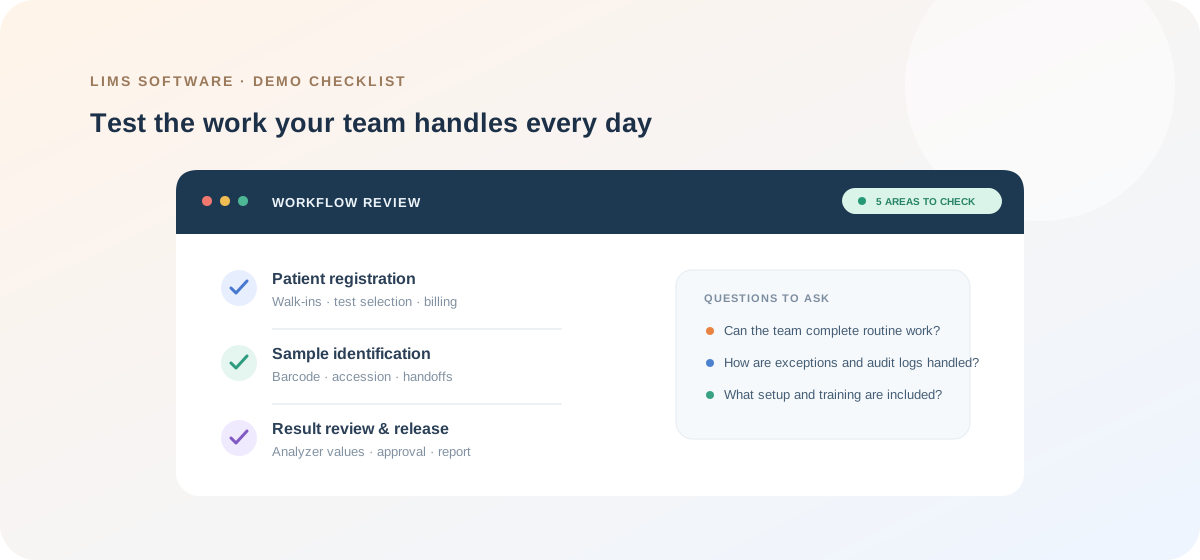
What to Expect in a Pathology LIMS Software Demo: Workflows to Evaluate Before Choosing a System
A guided evaluation framework for Indian diagnostic laboratory owners and staff to test real-world workflows—from pre-analytical accessioning to analyzer interfacing, NABL audit readiness, and reporting—during a LIMS software demo.
Selecting a laboratory information management system (LIMS) is one of the most consequential operational investments a diagnostic laboratory will ever make. In India's fast-moving healthcare landscape, pathology laboratories face increasing demands: growing patient volumes, complex multi-center collection logistics, pressure for faster turnaround times (TAT), and compliance requirements under standards such as ISO 15189. Unfortunately, many software demonstrations turn into passive vendor slide decks that showcase sleek dashboards while glossing over real benchtop practicalities. To make an informed choice, laboratory directors, pathologists, and technical managers must take control of the demo and evaluate their lab's actual operational workflows step by step.
Pre-Analytical Phase: Patient Intake, Phlebotomy, and Sample Traceability
The pre-analytical stage accounts for a significant portion of diagnostic errors. During the demonstration, ask the vendor to execute registration exactly as your front desk and phlebotomy stations do during peak morning hours. Observe how quickly registration forms handle walk-in patients, corporate health checkups, and doctor-referred investigations with differential rate lists.
Sample labeling is a common audit focus under NABL guidelines, where hand-written labels or ambiguity in sample identity can trigger non-conformances. Have the vendor demonstrate barcode generation directly from the order screen. Key capabilities to test include:
- Dynamic barcode printing that outputs unique identifiers mapped to patient visit ID, sample tube type (e.g., EDTA, plain, fluoride, citrate), and target workstation.
- Digital accessioning and phlebotomy timestamping to monitor pre-analytical waiting and collection times accurately.
- Sample rejection workflows that log the reason (e.g., hemolyzed, lipemic, clotted, or insufficient volume), record notification of the clinician or patient, and automatically update accessioning logs.
Analytical Phase: Bidirectional Interfacing and Quality Control Management
A LIMS should eliminate manual result transcription, which is both labor-intensive and prone to data entry mistakes. During the demo, examine the system's analyzer interfacing capabilities. Inquire specifically about bidirectional communication using industry standard communication protocols like ASTM and HL7. With bidirectional interfacing, the analyzer reads the barcoded sample, queries the LIMS for the pending worklist, runs the prescribed tests, and transmits the findings back automatically.
Equally vital is internal quality control (IQC) management. ISO 15189:2022 emphasizes analytical risk mitigation and active quality verification before patient reports are processed. Evaluate whether the software can:
- Capture multi-level control runs directly from interfaced instruments without technician manipulation.
- Plot automated Levey-Jennings (L-J) charts with standard deviation (SD) and coefficient of variation (CV) calculations.
- Enforce multi-rule Westgard checks (such as 1-3s, 2-2s, or R-4s) with automated warning alerts and rule-violation logging before releasing batch test runs.
Post-Analytical Phase: Clinical Validation, Delta Checks, and Pathologist Sign-Off
The validation screen is where your pathologists spend substantial time, so its layout and diagnostic safety checks are critical. Ask the demonstrator to show a multi-parameter test report, such as a complete blood count (CBC) or comprehensive metabolic panel. Assess how clearly the interface highlights abnormal values, critical/panic ranges, and age- or gender-specific biological reference intervals.
Request a demonstration of the delta check feature: when a patient has a prior history, does the system flag sudden, biologically improbable shifts compared to past records? For final authorization, evaluate the multi-level sign-off workflow, secure digital signature integration, and the generation of formatted, branded PDF reports containing QR codes for report authenticity verification.
Multi-Center Logistics and B2B Partner Workflows
Many diagnostic practices in India operate on a hub-and-spoke model, consolidating samples from peripheral collection centres, hospital labs, and franchisee outlets. Generic systems often falter under the logistical complexity of distributed accessioning.
Ask the vendor to walk through the journey of a sample collected at a remote spoke center and shipped to the central processing hub. The demo should show batch creation, manifest generation, dispatch tracking, receipt confirmation, and rejection at the receiving hub. Additionally, examine the partner billing modules: does the software manage partner credit limits, generate B2B invoices, and support split settlements seamlessly?
Audit Trails, Security, and Compliance Readiness
Accreditation assessors evaluate how rigorously a laboratory controls data modifications. In the demo, ask the vendor to simulate a scenario where an authorized user edits an already approved result or cancels a bill. Observe whether the software enforces a strict audit trail: recording the identity of the user, the exact timestamp, the previous value, the new value, and a mandatory clinical reason for the change.
Verify role-based access controls (RBAC) to ensure technicians, front-desk executives, and consultants only have access to functions aligned with their responsibilities. For laboratories integrating into broader digital ecosystems, inquire about compliance with national digital initiatives, including Ayushman Bharat Digital Mission (ABDM) guidelines for creating Ayushman Bharat Health Accounts (ABHA) and linking diagnostic records.
Structuring Your Evaluation Framework
Before scheduling your demo, establish a standardized vendor scorecard covering clinical usability, instrument compatibility, reporting turnaround times, and total cost of ownership. Request that vendors use representative test datasets rather than static mockups. By testing each workflow against your laboratory's daily realities, you can confidently choose a LIMS that strengthens diagnostic precision, safeguards compliance, and supports sustainable growth.
Sources
- labclia.com · vertexaisearch.cloud.google.com
- lisfi.in · vertexaisearch.cloud.google.com
- novopath.com · vertexaisearch.cloud.google.com
- softcomputer.com · vertexaisearch.cloud.google.com